
ABOUT US
Our History & Creation
Two ways of knowing our story: the documented history of the Munsee-Delaware people’s settlement on the Thames River, and the oral creation traditions passed down by our elders. Explore the historical record of our arrival on the Thames, the maps that document our villages, and the creation story as told by Chief Waubuno.
OUR HISTORY
Munsee-Delaware & the Thames River
The Munsee people originally lived near the Hudson River, close to present-day New York City. They were part of the Lunaapeew — which included both the Munsee and Unami peoples, named “Delaware” by English colonists after the colony of the same name.
After years of conflicts and broken treaties with European colonial powers, the Munsee people moved northwest toward the Great Lakes, following the rivers of New York and Pennsylvania. By 1783, over 500 Munsee people were living along the Niagara River. Between 1783 and 1785, a large group moved further west — establishing four villages along the Thames River by 1785.
The Thames River offered distinct advantages: flat, farmable land similar to earlier Delaware homelands, a trading link to Detroit, and a strong alliance with the neighbouring Chippewa people. The community that took root here has remained on the northern shore of the Thames ever since.

Thames River Settlement 1785–1795
An Established Community
The Thames offered flat farmable land, a trading link to Detroit, and a strong alliance with the neighbouring Chippewa people. The community was well established long before European settlement reached the region.
Four Villages on the Thames
An upper village near present-day Muncey, a middle village, a lower village near the current reserve, and a fourth on the south bank along the path toward Lake Erie at present-day Port Stanley.
Documented by Missionaries
In March 1791, Moravian missionary David Zeisberger recorded the “Monseys on the Thames.” Within a year the community was sharing surplus corn with the Moravian mission at Fairfield — evidence of years of established farming well before 1792.
Governor Simcoe’s Visit, 1793
On February 15th, 1793, Major Littlehales recorded being “cordially received by the Chiefs” at the upper village — noting cleared meadows planted with corn along the river. The party stopped again on the return journey February 27th.
Historical Maps
Documented on the Land
Beginning in 1792, surveyor Patrick McNiff was commissioned to map the Thames River. The resulting maps confirm the location of Munsee-Delaware villages, corn fields, and travel routes — notably containing no European towns or settlements, as Munsee settlement predates all European settlement in the area.
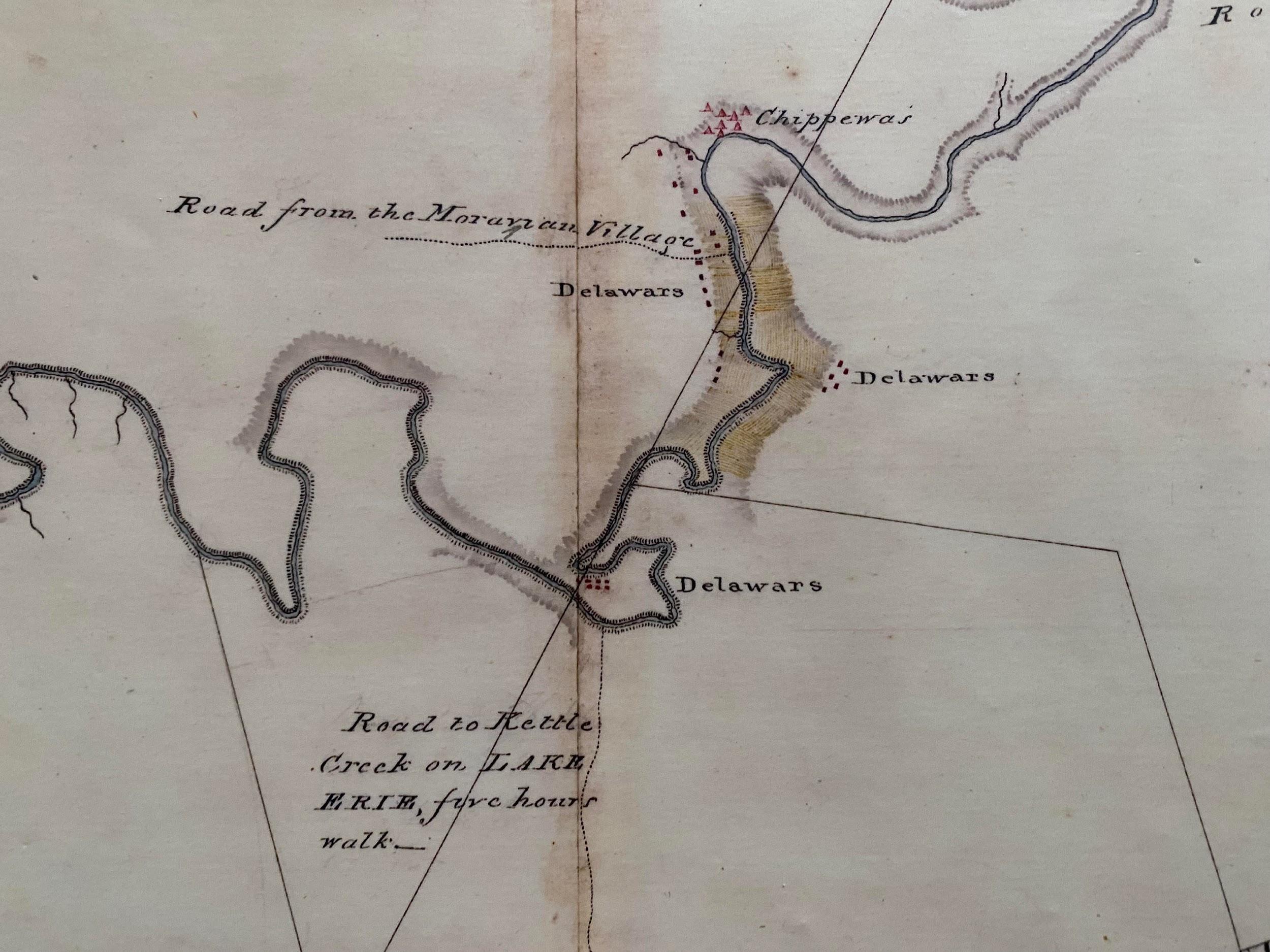
Plan of the River Thames, 1795
Three Munsee-Delaware villages, corn fields, and roads to the Moravian village and Kettle Creek.
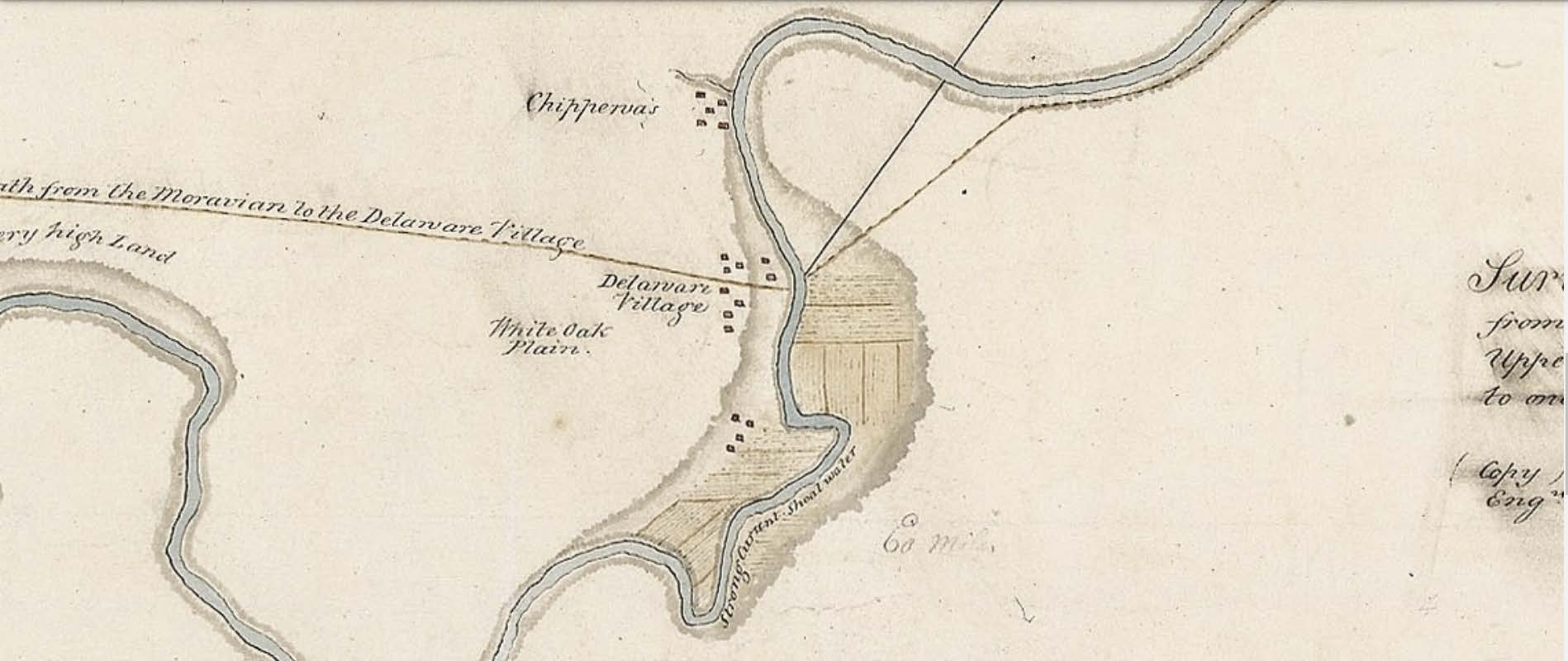
Survey of the River La Tranche, 1795
Confirms the south-bank village as the largest settlement, corroborated by 1870s testimony.
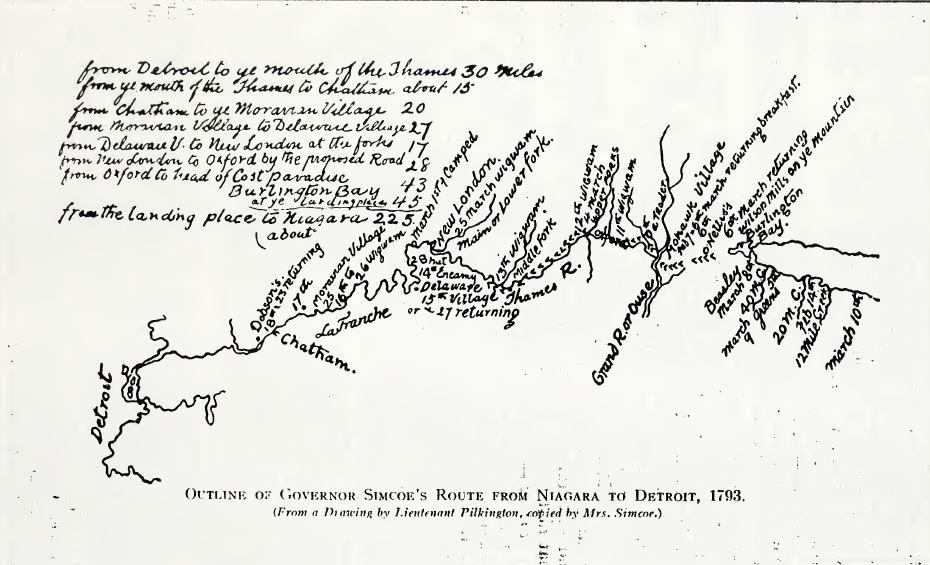
Governor Simcoe's Route, 1793
Drawn by Mrs. Simcoe — shows the Niagara to Detroit route with the Delaware village marked.
Oral Tradition
Traditions of the Delawares
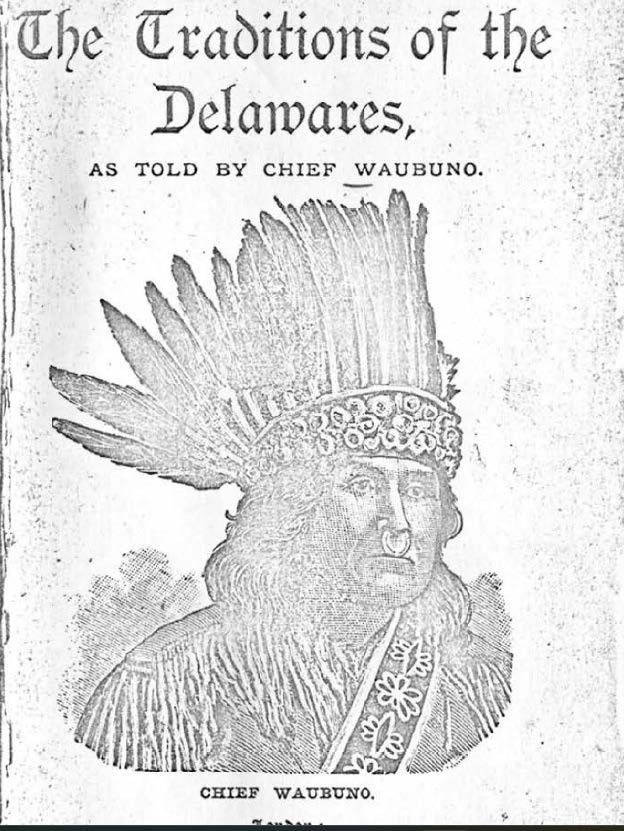
Chief Waubuno (John Wampum)
Born at Munceytown, 1815 • Buried at Delaware Chapel, Six Nations
For years, Chief Waubuno gathered the beliefs and stories passed down by the aged sachems of the Munsee and Delaware nation — the traditions transmitted from their forefathers about the origin of their people and the creation of the world.
The Great Spirit — known in Munsee as Kaunzhe Pah-tum-owans, or Kacheh Munitto (Benevolent Spirit) — created all nations and gave each their own language, customs, and ways of living. To forsake the old ways would be to give offence to the Creator.
Among the traditions preserved by the Munsee is the story of Amen-a-push — a great man who, when the world was flooded, gathered animals and fowls, constructed a raft from a cedar tree, and set about creating a new world from the earth retrieved by the muskrat from beneath the waters.
Amen-a-push took the earth he found in the musk-rat’s paws and mouth, and having rubbed it with his hands to a fine dust, he placed it on the waters and blew upon it — then it began to grow larger and larger until it was beyond the reach of his eyes.
From the Traditions of the Delawares, as told by Chief Waubuno
This is a passage from the full creation account — including the story of the great flood, the two creatures whose quarrel caused it, Amen-a-push’s cedar tree and raft, and the muskrat’s journey to retrieve earth from beneath the waters.
QUESTIONS?
Get In Touch
For more information about Munsee-Delaware Nation History & Creation, reach out to our team.